Michael Caine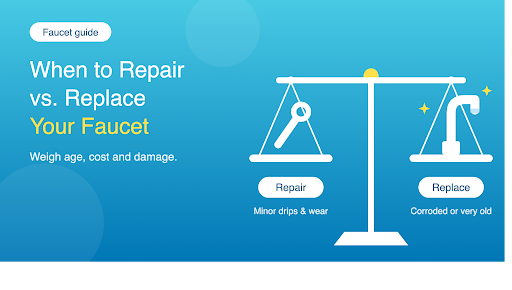
Every faucet eventually reaches a point where you have to make a decision: fix it, or replace it. And the honest truth is that the right answer isn’t always obvious.
Some faucets are worth repairing for another decade. Others are throwing money away the moment you buy a replacement cartridge for them. The difference comes down to a handful of factors that have nothing to do with how the faucet looks and everything to do with what’s happening inside it.
Here’s a framework for working through the decision—the same reasoning a plumber uses when they’re standing at your sink.
The Two Questions That Matter Most
Before you get into details, answer these two questions honestly.
Question one: What is the faucet actually made of?
A faucet with a solid brass body and a ceramic disc cartridge is a fixture worth maintaining. A faucet with a plastic body, a rubber-washer compression stem, or a zinc-alloy housing is not. The materials determine whether repair is an investment or a delay.
Question two: How much of the faucet’s value has already been used?
A faucet costs money to buy and money to maintain. If you’re being asked to put 40 percent of the faucet’s original price into repairs, and the fixture is already halfway through its expected service life, the math doesn’t work. You’re buying time, not solving a problem.
The Case for Repair
Repair is usually the right call when the problem is isolated to a wear component—the parts designed to fail eventually.
Repair makes sense when:
- The leak is coming from a known wear point. Dripping from the spout, water seeping around the handle base, or a slow leak at the aerator are all typical wear failures. These are the parts that are supposed to be replaceable.
- Replacement parts are readily available. If the manufacturer still supplies cartridges, O-rings, or stems for your model, the faucet has a supported repair path. That’s a strong signal it’s worth keeping.
- The faucet is a quality fixture. Brands known for solid construction and long parts availability are worth maintaining. A well-built faucet can outlast two or three cheap replacements.
- The body and finish are in good condition. No corrosion inside the housing, no cracking, no flaking finish. If the frame is sound, replacing the internals is straightforward.
- The repair is a single component. One cartridge. One O-ring set. One aerator. When a faucet fails in one place and everything else is healthy, that’s a maintenance job, not a replacement job.
- You like the faucet and it fits your sink. Compatibility has value. A faucet that fits properly, looks right, and functions the way you want it to is worth keeping alive if the cost of doing so is reasonable.
The Case for Replacement
Replacement becomes the better decision when the problem isn’t a wear component anymore—when it’s the fixture itself.
Replacement makes sense when:
- The faucet is low-cost or builder-grade. Fixtures in the sub-$100 range are often designed with a limited service life. If a builder-grade faucet needs more than a minor part, you’re usually better off putting that money toward something better.
- Parts are unavailable or cost nearly as much as a new faucet. This happens more often than people expect, especially with discontinued models. When a cartridge costs $60 and the faucet cost $90, the decision is already made.
- The failure is internal and structural. Corrosion inside the faucet body, a cracked housing, or a damaged valve seat that can’t be resurfaced means the fixture’s core is compromised. You can replace every removable part and still have a leaking faucet.
- The problem is recurring. If you’ve repaired the same leak twice in two years, the underlying issue isn’t a worn part—it’s a fixture that’s reached the end of its service life. Repeating repairs on a failing faucet is the most expensive path available.
- Water pressure or flow has degraded and cleaning hasn’t helped. Persistent low flow that isn’t resolved by descaling the aerator or cartridge often indicates internal scaling or corrosion that can’t be reversed.
- The faucet is outdated in a way that matters. Not cosmetic preference, but function—an old two-handle model where the cartridges are discontinued, or a fixture that doesn’t meet current standards for your setup.
- You’re already having work done. If a plumber is already on site for another reason, bundling a faucet replacement into that visit costs far less than scheduling a separate appointment later.
A Simple Scoring Approach
If you’re on the fence, score the faucet on these five factors. Give each one a point if it’s true.
- The faucet is under 10 years old.
- It’s a mid-range or premium fixture.
- Replacement parts are currently available.
- The body and finish show no corrosion or cracking.
- This is the first significant repair it has needed.
Four or five points: Repair. The fixture has life left in it.
Two or three points: It’s a judgment call. Consider the cost of the repair against the cost of a comparable replacement, and lean toward replacement if the repair exceeds a third of the new fixture’s price.
Zero or one point: Replace. You’re spending money on a fixture that’s already finished.
What People Get Wrong
The most common mistake is treating repair as the automatic “cheaper” option. It isn’t always.
If a $40 repair buys you eight more months on a faucet you’ll replace anyway, you haven’t saved money—you’ve spent $40 and delayed the inevitable. And if that repair involves a plumber’s time, the cost gap between repair and replacement narrows considerably.
The second mistake is replacing a faucet that only needed a five-dollar part. Quality fixtures are expensive, and throwing one away over a worn O-ring is wasteful. If the frame is sound and the parts are available, repair is almost always the smarter financial decision.
The third mistake is ignoring the plumbing behind the faucet. Supply lines and shut-off valves age on the same timeline as the fixture. If they’re in poor condition, the real question isn’t repair versus replace—it’s whether the whole assembly needs attention at once. It’s far easier to address all of it while the faucet is off the sink.
If you’re weighing a repair and aren’t sure what’s actually wrong, having someone diagnose it first is worth the visit. In many cases, what looks like a fixture failure turns out to be a single worn component. In others, a fixture that seemed worth saving has corrosion that rules repair out entirely. Professionals offering faucet replacement services can usually tell you which situation you’re in within a few minutes of looking at it.
The Repair-or-Replace Timeline
It helps to think about faucets in phases.
Years 0–5: Almost everything is worth repairing. The fixture is still in its prime, and failures are typically minor.
Years 6–10: Repair is still usually the right call for quality fixtures, but start paying attention to parts availability and whether the manufacturer still supports the model.
Years 11–15: This is the transition zone. Repair costs begin to approach the value of the fixture, and recurring problems become more likely.
Beyond 15 years: Repair is only worthwhile if the faucet is high-end, parts are still available, and the body is in genuinely good condition. Otherwise, replacement is the more economical path.
Making the Call
The decision comes down to three things: the quality of the fixture, the availability of parts, and whether the failure is a wear component or a structural one. Get those three answers, and the right choice usually becomes obvious.
When in doubt, remember that a faucet is a long-term purchase. Replacing a worn-out fixture with a good one means you won’t think about it again for a decade. Repairing a failing one means you’ll be back in the same position before long.
For homeowners who’d rather have the diagnosis done properly the first time, Fix Mechanical works on residential and commercial plumbing throughout the Isanti area and can advise on whether a repair is worth doing or whether it’s time to move on. There’s no universal answer—only the answer that makes sense for your specific fixture and your specific plumbing.